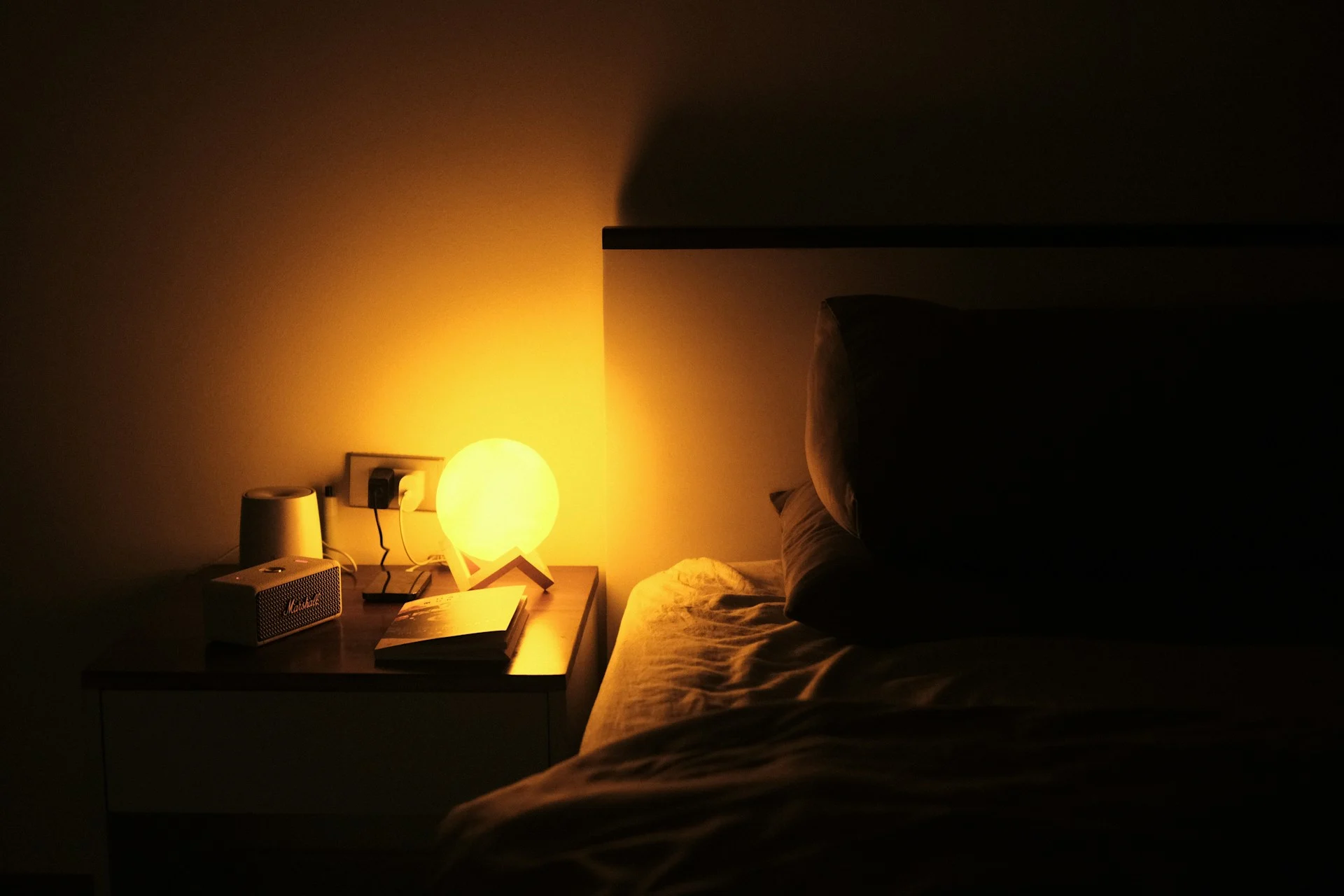
Tired but wired means your sleep pressure is high but your alert system hasn't switched off. The best fix tonight: stop trying to sleep, write tomorrow's to-do list, and slow your exhale. Don't blame "adrenal fatigue," which isn't a real diagnosis.
It’s 11pm. Your body feels like wet sand. You’ve been yawning since dinner. Then you lie down, turn off the light, and your brain switches on like someone flipped a breaker. Tomorrow’s meeting. The text you never answered. A song from 2009.
That’s tired but wired. Exhausted and alert at the same time, which feels like it shouldn’t be possible. It is, and once you see why, it gets a lot easier to fix. Here’s what’s going on, the popular explanation I’d skip, and what actually helps tonight.
What “Tired but Wired” Actually Means
Two systems control sleep, and they pull on you at the same time.
The first is sleep pressure. The longer you’re awake, the more of it builds, and it’s the heavy, yawning, wet-sand feeling. The second is everything that keeps you alert: your body clock, stress, light, caffeine, a mind still chewing on the day. Sleep researchers have described this push and pull for decades; the classic version is called the two-process model of sleep regulation (Borbély et al., 2016).
Normally the two line up. Sleep pressure rises, alertness fades, and you drop off. Tired but wired is what happens when they don’t. The pressure is there. The alerting signal just hasn’t stood down.
When that mismatch becomes a nightly pattern, researchers call it hyperarousal. A 2010 review in Sleep Medicine Reviews put an imbalance between arousing and sleep-inducing brain activity at the heart of chronic insomnia (Riemann et al., 2010). Worry keeps it going, and so does learning to link the bed with being awake. Most people who feel tired but wired don’t have insomnia. But it’s the same machinery, running a little hot.
Why It Happens

I used to think my wired nights were random. They weren’t. Once I started paying attention, the same few causes showed up over and over.
Your body clock has a built-in second wind
This one surprised me. Your circadian system pushes hardest for wakefulness in the evening, right before your usual bedtime, to keep you going through a long day’s sleep pressure.
In a 1987 study of 15 people living without clocks or daylight cues, researchers found specific windows when people almost never fell asleep. They predicted one of those zones lands roughly one to three hours before a person’s habitual bedtime (Strogatz, Kronauer & Czeisler, 1987). Sleep scientists now call it the wake maintenance zone.
So if you crash on the couch at 8:30, “push through” to 10, and then feel weirdly alert, you walked straight into your clock’s second wind. Nothing is broken. It’s also why going to bed two hours early after a bad night often backfires.
Evening is the first quiet you’ve had all day
If your day is wall-to-wall, your brain finally gets an empty room at 11pm. Of course it starts unpacking. Everything you didn’t have time to think about arrives at once.
This is the same engine behind revenge bedtime procrastination, where you stay up on purpose to claw back some time that’s yours. Whether you’re scrolling or staring at the ceiling, the problem is that the day never got a proper ending.
Screens and bright light
Light in the evening tells your clock it’s still daytime. In a lab study at Brigham and Women’s Hospital, young adults read either a light-emitting eReader or a printed book before bed. On the eReader nights they took longer to fall asleep, their melatonin was suppressed and delayed, and they were less alert the next morning (Chang et al., 2015). The phone you scroll “to relax” is doing a version of the same thing, plus it hands your brain fresh things to react to.
Caffeine later than you think
You might feel fine having coffee at 3pm. Your sleep might not agree. In a small study of 12 healthy sleepers, 400 mg of caffeine taken six hours before bed still measurably disrupted their sleep (Drake et al., 2013). Most of them didn’t notice it had. That’s a big dose, roughly three or four strong cups, but it’s a useful warning about the afternoon top-up.
A hard workout right before bed
Exercise usually helps sleep, including in the evening. A 2019 meta-analysis of 23 studies found evening exercise didn’t harm sleep overall. The exception was vigorous exercise ending about an hour before bed, which might make it take longer to fall asleep (Stutz et al., 2019). A walk after dinner is fine. A 9:45pm spin class might be the thing keeping you up.
It’s Probably Not Your Adrenals
Search “tired but wired” and you’ll quickly land on adrenal fatigue. The idea is that chronic stress wears out your adrenal glands and wrecks your cortisol, leaving you exhausted by day and buzzing at night. It usually comes with a saliva test and a supplement stack.
I’d skip it. A systematic review in BMC Endocrine Disorders went through the research and found no substantiation that adrenal fatigue is an actual medical condition (Cadegiani & Kater, 2016). Stress does affect cortisol, and cortisol has a real daily rhythm. But “your adrenals are burned out” isn’t a diagnosis that holds up. Buying your way out of it with pills skips the causes you can actually change. (I went through what stress hormones really do, and what a calming practice can change, in does meditation lower cortisol.)
If your exhaustion is extreme or comes with other symptoms, see a doctor and get real tests. More on that at the end.
How to Get Unwired Tonight
When you’re already lying there buzzing, stop feeding the alert side and give sleep pressure room to win. Here’s the sequence I use, roughly in order.
- Stop trying to sleep. Effort is alerting. Telling yourself “I have to sleep now” is a small act of pressure, and your body reads pressure as a reason to stay up. Aim for rest instead. Lying still in the dark with your eyes closed still counts for something.
- Get the list out of your head. Keep paper by the bed and write down tomorrow’s to-do list, as specifically as you can. In a sleep-lab study, people who wrote a to-do list for five minutes before bed fell asleep about nine minutes faster. The comparison group wrote about tasks they’d already finished. The more specific the list, the faster they dropped off (Scullin et al., 2018). If you need a fuller version, a quick brain dump does the same job for the non-task noise.
- Lengthen your exhale. Breathe in through your nose for about four counts and out for six to eight, for two or three minutes. Slow breathing with a long exhale nudges your body toward its rest mode. The physiological sigh (a double inhale, then a long, slow exhale) is a good one to try here.
- Give your body the off switch. Tense and release your muscle groups one by one, feet to face. That’s progressive muscle relaxation. A slow body scan works too. You’re giving your attention something physical and boring to hold, which is exactly what a wired brain needs.
- Bore your mind. If thoughts keep grabbing you, try cognitive shuffling: pick a random word and picture unrelated objects that start with each of its letters. It crowds out the worry without giving you anything worth staying up for.
- Get up if it’s been a while. If you’ve been awake and frustrated for what feels like 20 minutes, get up. Go somewhere dim, do something quiet and dull, and come back when you feel sleepy. This is a standard part of insomnia treatment, and it stops your bed from becoming the place where you lie awake. I go deeper on this loop in sleep anxiety.
Don’t check the time while you do any of this. Every glance at the clock starts a little math problem in your head, and math is alerting.
Fix the Hour Before Bed (and the Day)

The tonight steps help. But if you’re wired most nights, the real fix happens earlier, when your evening is still ahead of you.
Give the day an ending. Pick a time, an hour before bed, after which you’re off. Lights down, screens away or at least dim, no new problems. A night-time routine works as a signal that the day is over, repeated until your body believes it. The chamomile is optional.
Move your worry earlier. If your mind saves everything for 11pm, give it a slot at 7pm instead. Ten minutes with a notebook: what’s bugging you, what you’ll do about it, what you can’t do anything about tonight. Then, when it comes back at bedtime, you can honestly tell yourself it’s handled until tomorrow.
Set a caffeine cutoff. Try no caffeine after noon or 1pm for two weeks and see what changes. Remember the Drake study: you might not feel the difference at night, but your sleep often does.
Move hard training earlier. Keep easy movement in the evening if you like it. Save the sprints and heavy sessions for earlier in the day when you can.
Watch the early-bedtime trap. After a rough night, the urge is to go to bed at 8:30. Because of that evening second wind, you’ll often just lie there wired. Keep your usual bedtime, and keep your wake time steady too.
Where Meditation Fits
Most of what keeps you wired is arousal: a body and mind that haven’t stood down. That’s precisely what a regular meditation practice trains.
In a randomized trial of 54 adults with chronic insomnia, eight weeks of mindfulness-based training cut total time awake at night. It also reduced pre-sleep arousal, compared with people who only tracked their sleep (Ong et al., 2014). It was a small study, and those were people with a diagnosed sleep problem, so I wouldn’t promise anyone a cure. But “less pre-sleep arousal” is the exact thing tired but wired is missing.
What I’ve noticed, in myself and in people I’ve taught, is that the practice that helps most at night is the one you did during the day. A ten-minute sit at lunch teaches your attention to let go of a thought. At 11pm that skill is already there to use.
When you’re exhausted, it’s easier to follow a voice than to run a practice yourself. The Declutter The Mind app has guided practices for these moments: before sleep, a restless mind at night, and falling back asleep. You can also start with a free guided sleep meditation, or read our guide on how to meditate before bed.
When It’s More Than a Bad Week
A few wired nights around a stressful stretch is normal. Talk to a doctor if:
- it’s happening most nights for more than a few weeks, or it’s wearing down your days,
- it comes with a racing heart, sweating, weight loss or feeling shaky (thyroid problems and some medications can cause this),
- you snore loudly, wake gasping, or feel exhausted however long you sleep (worth checking for sleep apnea),
- it rides along with low mood, constant worry or panic.
For persistent insomnia, the first-line treatment is CBT-I, cognitive behavioral therapy for insomnia. A 2015 meta-analysis of 20 trials found it produces meaningful, lasting improvements without the downsides of sleep medication (Trauer et al., 2015). Meditation is a good complement to that kind of care. It isn’t a replacement for it.
And if the sleepless nights come with hopelessness or thoughts of hurting yourself, please don’t wait them out. In the US you can call or text 988 any time.
For most people, though, a wired night is a day that never got an ending, colliding with a clock that hits its second wind at bedtime. Tonight, try the list and the long exhale. Tomorrow, start the ending an hour earlier.
Frequently Asked Questions
What does tired but wired mean?
It means your body is exhausted but your mind stays alert, so you can’t fall asleep. Your sleep pressure is high, but the systems that keep you awake (your body clock, stress, light, caffeine) haven’t stood down yet.
Why am I tired but can’t sleep?
Usually because something is still keeping you alert at bedtime: stress you haven’t processed, bright screens, caffeine from the afternoon, a hard late workout, or going to bed during your body clock’s evening second wind. Sleep pressure alone isn’t enough when the alerting side is still switched on.
Is tired but wired a sign of adrenal fatigue?
No. A 2016 systematic review found no substantiation that adrenal fatigue is a real medical condition. If you’re exhausted for weeks or have other symptoms, see a doctor and get proper tests instead of buying cortisol supplements.
How do I calm down when I’m tired but wired?
Stop trying to force sleep, write tomorrow’s to-do list on paper, and breathe with a long, slow exhale for a few minutes. If you’re still awake and frustrated after about 20 minutes, get up, do something dull in dim light, and go back when you feel sleepy. Our guide to sleep anxiety covers that loop in more depth.
Can anxiety make you tired but wired?
Yes. Worry keeps your mind alert, and stress hormones and a racing heart work against sleep even when you’re exhausted. If it happens most nights or comes with panic or low mood, talk to a doctor or therapist.

Amber is the content manager and outreach specialist at Declutter The Mind. She enjoys yoga, MMA, and of course, meditation!