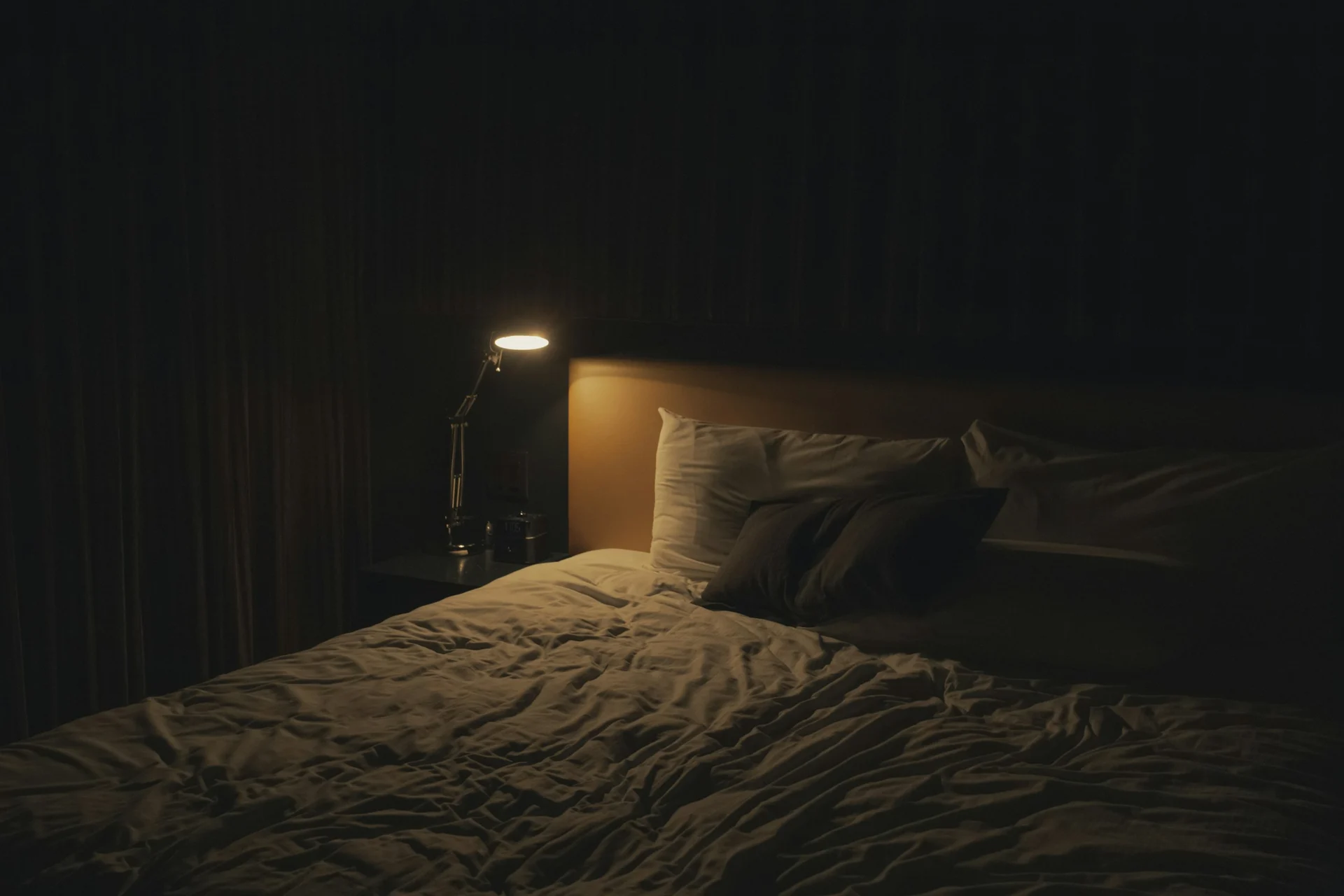
Revenge bedtime procrastination is delaying a bedtime you meant to keep, with nothing stopping you. Research says it's a stopping problem, not weak willpower, so don't rely on discipline at midnight. Make bed automatic with an if-then plan and move your phone out of the room.
It’s 11:40pm. Your eyes are stinging. You told yourself you’d be asleep by eleven, and part of you knew even then that you wouldn’t be. But here you are, thumb still moving, one more video, one more chapter, one more scroll through nothing in particular. You can feel exactly how much tomorrow is going to hurt. And you keep going anyway.
If that’s you a few nights a week, you’ve probably seen the name for it: revenge bedtime procrastination. It’s a good name. It’s also pointing you at the wrong fix.
Most advice treats this as a willpower problem. Just go to bed. Have more discipline. Put the phone down. If that worked, you’d have done it by now. What the research actually shows is that staying up late when you’re exhausted is less about weak character and more about a specific kind of stuckness, and the things that fix it aren’t the things you’d guess. Let’s get into what’s really happening and what to do instead.
What Revenge Bedtime Procrastination Actually Is

Here’s the plain version: you delay a bedtime you meant to keep, even though nothing is stopping you from sleeping and part of you wants to.
That definition comes from a 2014 paper by Floor Kroese and colleagues at Utrecht University, who coined the term “bedtime procrastination” and defined it as voluntarily delaying bedtime without an external reason to do so. No newborn crying. No night shift. No emergency. You have the opportunity to sleep and the intention to sleep, and you stay up anyway.
The “revenge” part got added later. It comes from a Chinese social-media phrase, roughly “retaliatory staying up late,” that went viral in English around 2020. The idea is that if your whole day belongs to your job, your commute, your kids, and your inbox, then those late hours after everyone’s asleep are the only time that feels like yours. So you claim them, even at the cost of the sleep you need.
I think that story is half-right, and I’ll come back to why the half that’s wrong matters. But first, one distinction that saves people a lot of confusion.
This is not insomnia. Insomnia is when you’re in bed, you want to sleep, and your body won’t let you fall asleep. Revenge bedtime procrastination is the opposite problem: your body is ready, and you won’t get in bed. They can overlap, and the racing thoughts that show up once you finally do lie down are their own separate thing. But if the honest answer to “why are you still awake?” is “because I haven’t gone to bed yet,” this is procrastination, not a sleep disorder. That’s actually good news, because it means the lever is behavioral.
Why It’s a Stopping Problem, Not a Willpower Problem
Here’s the finding that reframed this whole thing for me.
When researchers actually asked people why they went to bed late, most of them didn’t describe a decision to postpone sleep at all. In a 2019 qualitative study, Nauts and colleagues interviewed frequent bedtime procrastinators and found that the problem usually wasn’t choosing to stay up. It was failing to stop what they were already doing. Nobody sits down at 11pm and thinks “I will now rebel against my bedtime.” You’re mid-episode, mid-thread, mid-scroll, and the transition to stopping just never happens.
That’s a completely different problem than a lack of discipline. You’re not fighting an urge to stay up. You’re failing to generate the small, effortful act of putting the thing down. And that act is hardest at exactly the moment you have to do it.
Because self-control isn’t a fixed trait you either have or don’t. It runs down over the day. Kroese’s larger 2016 study, using a representative sample of 2,431 Dutch adults, found that people lower in self-regulation slept less and felt more tired the next day, and that bedtime procrastination was the thing in the middle connecting the two. By late evening, after a full day of deciding and managing and holding it together, the part of you that’s good at stopping is the most worn out it will be all day. And that’s precisely when your bedtime shows up asking you to make a hard call.
So “just have more willpower at 11pm” is asking the most depleted version of you to rescue the situation. No wonder it keeps losing.
Some of us are more prone to this than others. If you’re a night owl by wiring, you’re swimming upstream. Evening chronotypes tend to procrastinate bedtime more, and the pull toward late nights raises the risk of insomnia symptoms partly through this exact procrastination loop. The useful thing to notice there is that chronotype is the part you can’t easily change, but the procrastination is the part you can. You don’t have to become a morning person to stop bleeding an hour of sleep every night.
What Actually Works

Once you stop treating this as a character flaw, the fixes get more interesting. They’re not “try harder.” They’re about changing the situation so that stopping doesn’t require heroics. Roughly in order of how much they help:
1. Fix the day, not just the night. This is the part the “revenge” label actually gets right. If the only time that feels like yours is after midnight, the real problem is upstream, in a day with no breathing room in it. More willpower at bedtime does nothing about that. What helps is claiming a genuine pocket of time earlier, in daylight, that’s yours and unscheduled. Twenty minutes after work that isn’t chores or a screen you feel obligated to check. A real lunch break away from your desk. It sounds almost too simple, but when the day has some slack in it, the night stops having to carry all of your leisure, and going to bed stops feeling like giving something up.
2. Make stopping automatic. Since the hard part is the decision to stop, the move is to make that decision in advance, when you’re rested, so the tired version of you doesn’t have to. The tool with the best evidence here is an “if-then” plan, sometimes called an implementation intention. You decide the trigger and the response ahead of time: “If it’s 10:30 and I’m on my phone, then I plug it in across the room and get in bed.” In two randomized trials, people who paired this kind of planning with first picturing the obstacle in their way ended up going to bed roughly half an hour earlier than they had been, and well ahead of a control group. A 2025 pre-registered study tested the same approach with tighter methods. Half an hour a night, from writing one sentence and rehearsing it, is a genuinely good return.
Write yours down. Make the trigger something you’ll actually notice (a time, a specific show ending, the moment you reach to open an app again) and make the response one concrete physical action.
3. Get the phone out of the room. Not because phones are evil, and not as a purity test. It’s about friction. The reason your phone wins at 11:40 is that it offers the most frictionless leisure ever invented, refreshing endlessly, requiring nothing from you. You will not out-discipline an infinite feed on your worst-rested willpower of the day. So don’t try. Charge it in another room and buy a cheap alarm clock. When the effort of getting up to grab it is higher than the effort of just closing your eyes, the whole equation flips. If the pull is strong, it’s worth looking honestly at your relationship with the feed itself, not just at bedtime.
4. Replace “go to bed” with an actual wind-down. “Go to bed” is a destination, not an action, which is part of why it’s so easy to defer. Give yourself a specific thing to do instead of the scroll, ideally something that lowers your arousal rather than spikes it. A warm shower. A few pages of a paper book. Building a consistent pre-sleep routine so the handoff happens on autopilot. A short guided practice you can follow with your eyes closed at bedtime. If you’d rather be walked through it than manage it yourself, there’s a before-sleep meditation in the Declutter The Mind library made for exactly this handoff, a way to give your attention somewhere to land that isn’t your phone. The point isn’t the specific ritual. It’s that “stop scrolling” is much easier when there’s a defined next thing, and much harder when the only alternative on offer is lying in the dark.
A 2-Minute Practice for the “Just One More” Moment
Sometimes you’re already past all of that. It’s late, the phone’s in your hand, and you can feel the “just one more” pulling. Here’s something short you can do right in that moment. I’d suggest reading it now so it’s there later.
- Stop moving your thumb, but don’t put the phone down yet. Just pause on whatever’s on the screen.
- Notice the urge to keep going. Don’t fight it and don’t obey it. See if you can feel it as a sensation, a kind of forward lean or pull, rather than a command you have to follow.
- Now drop your attention into your body for three slow breaths. Notice the actual tiredness that’s there. The heaviness behind your eyes. It’s usually more than you’d realized, because the screen has been covering it.
- Ask yourself what you’re really after right now. Most nights it isn’t the next video. It’s rest, or a few quiet minutes that feel like yours. Name the real thing.
- Then choose, from that clearer place. Sometimes you’ll still stay up, and that’s allowed. But you’ll be deciding it, instead of drifting into it. That difference is the whole skill.
If your mind wanders in the middle of this, or you catch yourself scrolling again before you’ve finished, that’s completely normal. Just notice it and come back. The practice is the noticing, not doing it perfectly.
When It’s More Than Procrastination
Most of the time this is an ordinary, fixable habit. Sometimes it’s a signal worth taking seriously.
If you’re genuinely trying to sleep and can’t, and that’s happening at least three nights a week for three months or more, that’s the clinical line for chronic insomnia, and it’s worth talking to a doctor. The best-supported treatment is a structured program called CBT-I, not a pill, and a GP can point you toward it.
And watch the reason underneath the staying-up. If those late hours aren’t really about freedom but about avoiding something, a low mood you don’t want to lie down with, a dread about tomorrow, a day you’re not looking forward to facing, that’s worth naming to a therapist. Procrastinating sleep to dodge a feeling is a different problem than procrastinating sleep out of habit, and it responds to different help. If you’re ever in real crisis, in the US you can call or text 988 any time.
None of that undoes the ordinary version. For most people, on most nights, this is just a stopping problem wearing a dramatic name. You don’t need more discipline. You need the day to have a little room in it, a decision made ahead of time, a phone across the room, and something to do with the last ten minutes besides scroll. Start with one of those tonight. See what the morning feels like.

Amber is the content manager and outreach specialist at Declutter The Mind. She enjoys yoga, MMA, and of course, meditation!