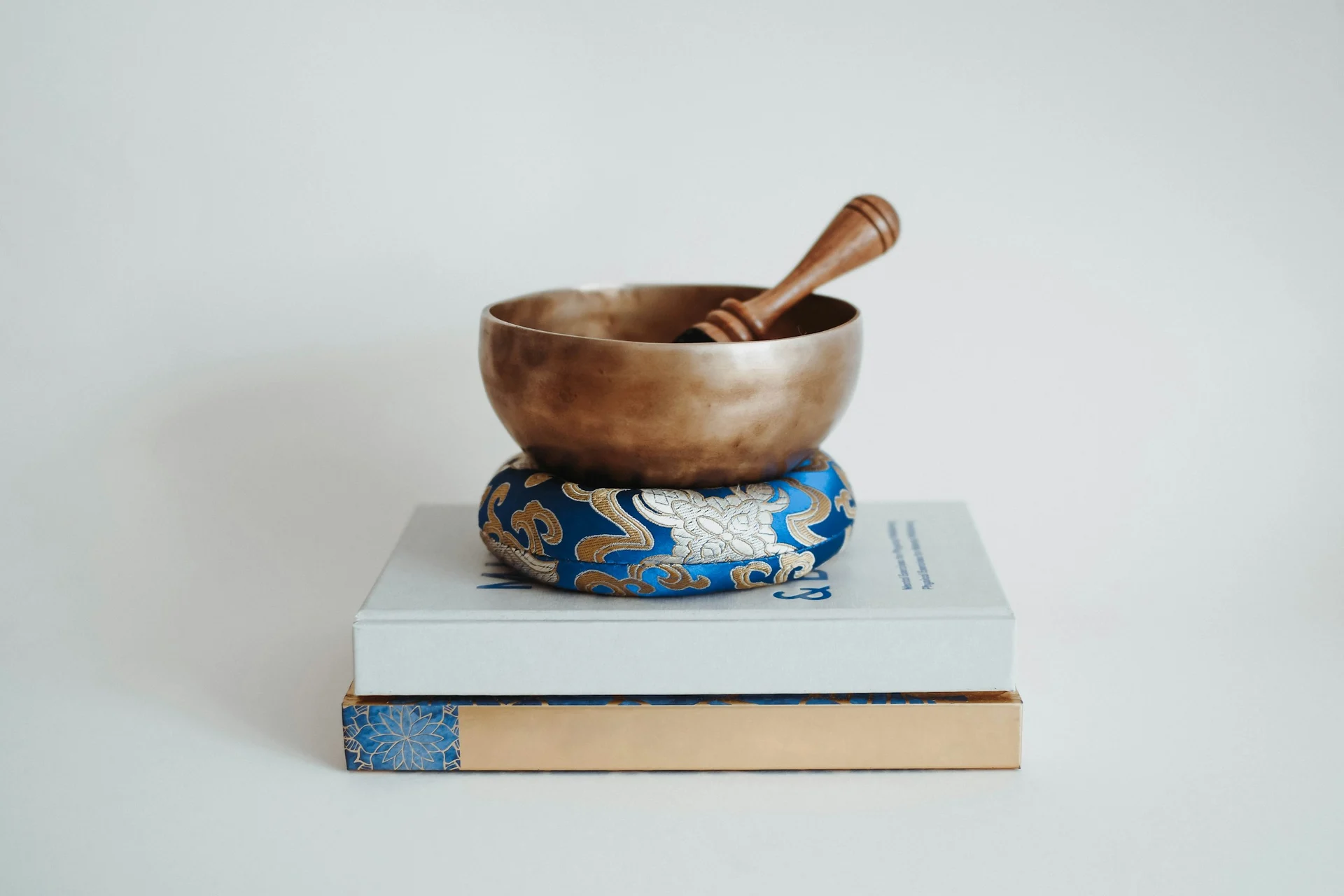
A sound bath is a guided sound meditation: you lie down while singing bowls and gongs play, and rest. It relaxes you through the relaxation response, not "healing frequencies." Try one in person, or get the same calm free with a guided meditation.
A friend invited me to my first sound bath the way you’d invite someone to brunch. Casual, a little smug, like she knew something I didn’t. I went in skeptical. I have spent years teaching secular, no-nonsense meditation, and everything about the phrase “sound bath” set off my hype alarm. Healing frequencies. Cellular retuning. The 432 hertz that supposedly fixes you.
Here is what I want to give you that most of the internet won’t: a straight answer. Sound baths are real, they can genuinely relax you, and the reason they work is not the reason you keep getting told. You do not have to believe in any of the mystical stuff to get something out of one. In fact, dropping the mythology makes the whole thing easier to enjoy.
What a Sound Bath Actually Is
A sound bath is a guided sound meditation. You lie down on a mat, usually with a blanket and a pillow, close your eyes, and a facilitator plays a set of resonant instruments around the room. Singing bowls, gongs, chimes, tuning forks, sometimes a simple drum. The sounds overlap and linger. You are not asked to do anything except listen and rest.
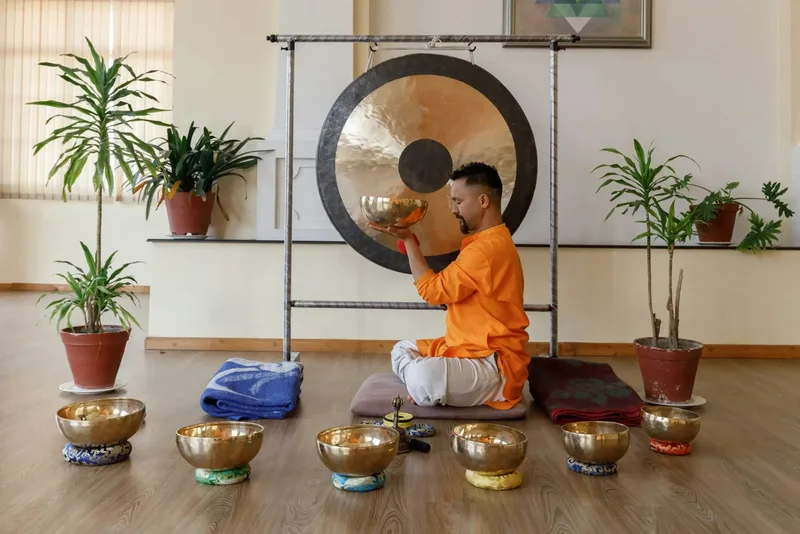
There is no water involved, which trips people up. The “bath” is a metaphor. You are being bathed in sound the way you might sit in warm afternoon light. A typical session runs 30 to 60 minutes, usually in a group at a yoga studio or wellness space, and it tends to end in a long stretch of stillness where nobody wants to move.
That’s it. No incense-scented obligation to feel transformed. You show up, you lie down, you listen.
Why It Can Calm You (the Real Reason)
When you look for an explanation of how sound baths work, you get some version of this: the sound waves entrain your brainwaves, slowing them from alert beta down to dreamy theta, and the resonant frequencies interact with your body’s energy centers to release what’s stuck. It sounds precise. It sounds scientific. Most of it doesn’t hold up.
The “entrainment” idea has been studied directly, mostly through binaural beats, which use sound to try to drive brain rhythms. A 2023 systematic review in PLOS ONE looked at the whole body of that research and found no clear trend either for or against the idea. Some studies showed the effect, more showed nothing, and where people did feel calmer, it looked like the general soothing effect of sound rather than any precise frequency reprogramming your neurons. Nobody has shown that a gong retunes your cells.
So why did I leave my first sound bath feeling like I’d had a nap and a massage at the same time?
The honest answer is the relaxation response. When you lie still in a safe space and rest your attention on a sound that is continuous, predictable, and non-threatening, your nervous system reads the room and stands down. Your breathing slows. Your shoulders drop. This is the same lever every calming meditation pulls, whether the anchor is your breath, a body scan, or the low ring of a bowl. Sustained, gentle sound is just an easy thing to pay attention to, which is exactly why it works for people who find silence unbearable.
You do not need the myth for the calm to be real. That is the part I wish someone had told me sooner.
What the Evidence Actually Shows
I want to be fair here, because “the mechanism is oversold” is not the same as “it does nothing.” The research on sound baths is genuinely promising and genuinely thin, and you deserve both halves of that sentence.
The most cited study is from 2017, published in the Journal of Evidence-Based Integrative Medicine. Sixty-two people did a singing bowl sound meditation, and afterward they reported significantly less tension, anger, fatigue, and low mood. First-timers felt the biggest drop in tension. Encouraging results, with one big catch: it was an observational study with no control group. Everyone lay down and rested, so we can’t cleanly separate the sound from the simple act of stopping for an hour.
A small randomized trial in 2023, published in the European Journal of Investigation in Health, Psychology and Education, tried to close that gap. Fifty anxious adults were split into three groups: a Tibetan singing bowl session, progressive muscle relaxation, or a waitlist that did nothing. The singing bowl group showed measurable physiological calming, higher heart rate variability and lower EEG alpha power, and both the sound and the muscle relaxation beat doing nothing for self-reported anxiety. Real signal. Also a tiny study, one single session, in people without a clinical diagnosis.
Then there’s the widest view: a 2020 systematic review in Complementary Therapies in Medicine that went looking for every solid study on singing bowls and found only four that met the bar. The researchers saw improvements in mood, anxiety, blood pressure, and heart rate, but concluded they could not recommend singing bowl therapy yet, because there simply wasn’t enough high-quality research to stand on.
Put it together and you get a reasonable verdict. Sound baths are relaxing, low-risk, and probably helpful for stress in the moment. They are not a proven treatment for anything, and anyone promising otherwise is selling you the frequency myth.
What a Session Feels Like
The first few minutes are the awkward part. You are lying on a floor with strangers, wondering if you’re doing it right, aware of every itch. Then the first bowl sounds and something shifts.
The tones overlap and stack until you lose track of where one ends and the next begins. Your mind wanders, of course it does, to your inbox and your grocery list and whether you locked the car. You notice, you come back to the sound, you drift again. That wandering is not failure. It is the practice.

Toward the end, when the instruments go quiet, there’s often a heavy, warm stillness that feels like the moment after a good cry or a deep sleep. Nothing mystical happens, and that is completely fine. You are not doing it wrong if you don’t see colors or feel your chakras open. You are doing it right if you feel more rested than when you walked in.
How to Try a Sound Bath
You have three real options, and they range from an event you book to something you can do in the next ten minutes.
In person. Search for sound baths at local yoga studios, meditation centers, and wellness spaces. Expect to pay for a class, sometimes a fair amount, and to lie on the floor for an hour. It’s the most immersive version, and being in a room full of overlapping sound really is different from headphones. Worth doing once if you’re curious.
At home with a recording. Plenty of sound bath and singing bowl recordings exist online, alongside other ambient sounds you can rest to. Put on headphones, dim the lights, lie down, and follow the same rules as a studio session: no phone, no multitasking, just rest and listen. If you own a singing bowl, even better, though you absolutely don’t need one.
The free shortcut. If what you’re actually after is the calm, not the ceremony, you can reach the same relaxation response with a plain guided meditation any time you want. A sound bath is usually paid, scheduled, and led by someone else. A guided session is free, on demand, and asks nothing of you but a few quiet minutes. At Declutter The Mind, the whole library is deliberately built without background music or mystical framing, because the benefit was never in the frequencies. If you’d rather try guided practices that lean on gentle sound and awareness, there’s a place to start with sound-based meditations without any of the woo.
Here’s a simple at-home version you can do right now:
- Lie down somewhere comfortable, blanket optional.
- Put on a sound bath recording or a soft, continuous sound you like.
- Close your eyes and let your body get heavy.
- Rest your attention on the sound. When your mind wanders, gently bring it back.
- Don’t try to feel anything in particular. Just listen.
- When it ends, stay still for a minute before you get up.
Who Sound Baths Suit, and Who Should Be Careful
Sound baths tend to click for people who find regular meditation frustrating. If sitting in silence makes your thoughts louder, a continuous sound gives your attention something to hold, which is why “I can’t meditate” people often love them. They also suit anyone carrying a lot of physical stress who just needs an excuse to lie down and switch off. If that’s you, a few simple relaxation techniques pair well with a session.
If you’re a highly sensitive person, you may find the immersion either wonderful or overwhelming, and both are valid. Trust your own response over anyone’s promises.
A few honest cautions. If you have tinnitus or real sound sensitivity, loud sustained gongs might not feel good, so start gentle and quiet. And to be clear, a sound bath is a complement to a healthy life, not a treatment. If you’re dealing with persistent anxiety or depression, this is a nice tool to have, but please talk to a professional too. Relaxation is not the same as care.
Frequently Asked Questions
Is a sound bath actually meditation?
Yes, in the practical sense. You’re resting your attention on a single anchor and returning to it when your mind wanders, which is the core of most meditation. The sound just makes the anchor easier to hold than your breath or silence.
Do I need singing bowls to try one?
No. You can experience a sound bath with a recording and a pair of headphones. Owning a bowl is nice but completely optional, and buying an expensive one won’t make the practice work any better.
Is the “healing frequency” thing real?
There’s no good evidence that specific frequencies retune your cells or fix your energy. The calming effect is real, but it comes from the relaxation response and focused attention, not from magic numbers like 432 hertz. You can enjoy the practice and skip the mythology.
How often should I do a sound bath?
As often as it helps and no more than that. Some people go to a monthly studio session; others use a recording a few times a week to wind down. There’s no dose you’re required to hit, so let it be a tool, not another obligation.
Can I do a sound bath before bed?
It’s a good fit for winding down, since the goal is deep rest rather than alertness. Do it lying down, keep the volume low, and don’t worry if you fall asleep partway through. That’s arguably the point.
You don’t have to choose between enjoying a sound bath and keeping your skeptic hat on. I do both. Lie down, let the sound do the easy work of holding your attention, and take the rest for what it plainly is. If that turns out to be your way in, the next step is just showing up for a few quiet minutes on a regular basis, sound optional.

Amber is the content manager and outreach specialist at Declutter The Mind. She enjoys yoga, MMA, and of course, meditation!