
Green noise is a steady, broadband sound centered around 500 Hz, like a waterfall or distant waves. It helps sleep by masking environmental noise and giving a wandering mind something steady to track. The evidence is real but thinner than the marketing: no trial has tested green noise specifically.
You searched “green noise” at 11pm because somebody told you it helps you sleep. Here’s the short version.
Green noise is a steady, broadband sound with most of its energy in the middle of the audible range. It sounds like a waterfall, ocean waves at a distance, or rain on a roof. People use it to mask environmental noise (traffic, snoring, hallway voices) and to give the wandering mind something steady to track. The evidence for it is real but smaller than the marketing suggests. It also isn’t the right tool for every kind of sleep problem.
This article gives you four things: what green noise actually is, how it works (the mechanism, not the hype), which color of noise to pick for which sleeper, and exactly how to use it tonight. No throat-clearing. Just what you need to make a call before you fall asleep.
What Green Noise Is (and What It Sounds Like)
Green noise is a type of broadband sound with its energy concentrated in the mid-frequency range, roughly around 500 Hz. That’s the only specific number anywhere in the technical literature on it (Wikipedia: Colors of noise). The result is a sound that’s noticeably warmer than white noise. Less hiss, less rumble, more “nature.”
If you’ve never heard it, picture one of three things: ocean waves heard from a distance, a steady waterfall, or heavy rain on a roof. Wind through tall grass is another close match. The shared quality is steadiness. There’s no melody, no rhythm, no surprise. Just a continuous wash of mid-frequency sound.
A short honest note on the term. “Green noise” emerged from sound-design and wellness contexts, not from acoustic physics. It doesn’t have the same rigorous definition as white noise (equal energy across all frequencies) or pink noise (equal energy per octave). Useful as a category label, less precise as a measurement. Most “green noise” tracks you’ll find online are broadband sound shaped to emphasize the middle of the audible range.
Why people prefer it: the mid-frequency emphasis sounds more like the natural world and less like static. If white noise has ever felt sharp or fatiguing to you, green is usually the answer.
How Green Noise Helps You Sleep
Green noise helps sleep through two real, well-understood mechanisms. Neither is mysterious. Neither is specific to “green.”
The first is acoustic masking. A steady broadband sound raises the auditory floor of the room. Brief louder sounds (a car horn, a partner shifting, footsteps in the hallway, the AC compressor kicking on) become less perceptually distinct against that floor. Your brain registers them less. The threshold for arousal goes up. You stay asleep through more.
The second is attentional anchoring. A steady sound gives the wandering mind something to follow. Instead of your thoughts running from “did I send that email” to “what if I get sick next year” to “should I check the time,” your attention has a continuous, predictable signal to track. The mental loop quiets down. Falling asleep gets easier.
Both mechanisms apply to any broadband noise. Whether the spectral profile is white, pink, brown, or green matters less than the masking + anchoring effect itself. This is the honest version of what wellness aggregators describe as “activating the rest-and-digest response.” It isn’t magic. It’s two well-documented effects: less arousal from environmental sound, and a passive anchor for the mind. The practical question then becomes: which color of noise do you actually want to listen to for an hour?
What the Research Actually Shows About Colored Noise and Sleep
No randomized controlled trial has been published specifically on green noise for sleep. Every “studies show green noise improves sleep” claim is extrapolating from research on white or pink noise onto a different spectral profile. Worth saying out loud, because no other article ranking for this topic does.
What we do have is strong evidence on white noise. A 2025 systematic review and meta-analysis pooled 12 randomized controlled trials and 1,301 participants (Ding et al. 2025). White noise improved sleep quality in adults (PSQI mean difference of -3.70, 95% CI [-4.90, -2.50], p<0.001) and in older adults (mean difference -2.71, [-4.98, -0.44]). That’s a meaningful effect, on par with what some non-pharmacological sleep interventions deliver.
The mechanism evidence is also solid. A 2017 study played broadband sound to healthy adults in a transient-insomnia model (Messineo et al. 2017). It reduced the time to reach stable Stage 2 sleep by 38%. That’s masking and anchoring in action.
The honest scope, though: a 2021 systematic review in Sleep Medicine Reviews concluded that across colored-noise interventions, the evidence is “mixed and of very low quality” (Riedy et al. 2021). Masking is mechanistically credible. The data on whether playing a noise track every night gives you reliably better sleep is thinner than the marketing suggests.
One more thing to keep straight. You may have read about pink noise enhancing deep sleep and memory in older adults (Papalambros et al. 2017). That research uses noise phase-locked to your brain’s slow oscillations via lab equipment. It’s not the same intervention as playing color noise from a speaker on your bedside table. Don’t conflate the two.
Green Noise vs White, Pink, and Brown: Which Color Is Best for Sleep?
The biggest follow-up question I see on this topic is “which color should I pick?” Here’s the clean version.
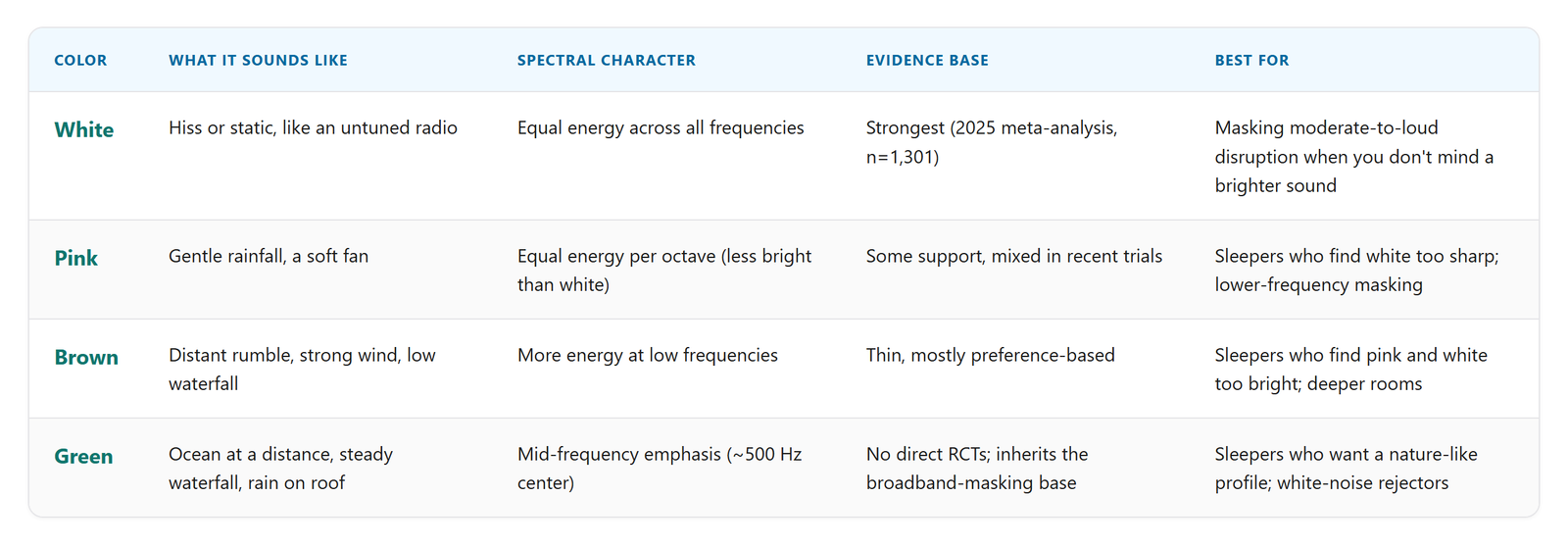
Comparison of white, pink, brown, and green noise for sleep.
There’s no clean “best” color. The mechanism (masking + anchoring) is the same across all four. If you can listen to a sound comfortably for an hour, you’ll get the benefits, whatever the color.
The honest caveat: most rigorous noise-for-sleep research is on white. None is specifically on green. And continuous overnight noise of any color has shown some downsides in recent work (more on that in the next section). The comparison is real, but the stakes between colors are smaller than the wellness internet implies. Pick the one whose sound you’d genuinely want to listen to.
When Green Noise Works Best (and When It Doesn’t)
Green noise is at its best in a few specific situations:
- You’re sleeping in a moderately noisy environment. Urban apartment, light traffic outside, a hotel hallway, a partner who snores softly, an HVAC system that drones.
- You’ve tried white noise and found it too sharp or fatiguing.
- You want a sound that evokes the natural world rather than a tuned-out radio.
It’s less useful when:
- The room is already very quiet. You’re adding sound rather than masking it, and some sleepers find the addition more arousing than helpful. Try a single night, see how you sleep.
- The disturbance is intermittent rather than continuous. A 2026 controlled trial in the journal SLEEP found that pink noise did not protect sleep architecture against intermittent environmental noise. Think traffic spikes, occasional barking, an AC that cycles loudly. It was also associated with reduced REM, and earplugs outperformed in that scenario (Basner et al. 2026). The same logic applies to green: against intermittent disruption, blocking sound is more effective than masking it.
- The actual issue is a racing mind. Color noise can help, but no passive sound is going to outrun thoughts that keep restarting on their own. That’s the bridge to the last section.
One more practical note. If your sleep issues persist for several weeks at a stretch, talk to a doctor. Colored noise of any spectrum won’t fix an underlying sleep disorder, and you don’t want to spend a year layering tracks when the right intervention is a CBT-I program or a sleep-study referral.
How to Use Green Noise Tonight
Five practical rules. Then you can stop reading and try it.
- Set the volume at or below 50 dB. That’s roughly the level of a quiet conversation across a small room. Higher volumes don’t help more, and continuous loud noise can damage hearing over time, especially in infant-sleep settings. The American Academy of Pediatrics specifically recommends keeping infant sleep machines under 50 dB. No competitor article on this topic gives a number. Now you have one.
- Pick whatever source is already convenient. A Spotify playlist, a YouTube track, a free ambient-sound site, a free phone app, a dedicated noise machine. They produce equivalent acoustic output if the recording is clean. You don’t need to spend money to test whether green noise works for you.
- Loop quality matters more than the brand. If the track restarts audibly every five minutes (a click, a fade, a noticeable seam), it’ll wake light sleepers. Pick something that’s at least 30 minutes long or generative (no restart points). Most paid sleep apps and the better free YouTube tracks handle this well.
- Run it from sleep onset until you fall asleep, not all night. A 30 to 60-minute timer is enough for most people. Running noise across the full night gives you the masking benefit at the cost of slightly suppressed REM in some recent studies. The trade-off favors a timer.
- Pair it with the basics. Cool, dark room. A consistent night-time routine. Screens off 30 to 60 minutes before bed. Green noise is one input. Stacked with the basics it works better than any of them alone, and it doesn’t substitute for any of them.
That’s it for the operational guide.
When Noise Alone Isn’t Enough
A warm bedside lamp glowing on a small nightstand at night.
There will be nights when the racing mind beats any sound. You can play green noise at the perfect volume, in the perfect loop, and still be lying there at 2am with your thoughts looping faster than the waterfall.
On those nights, the move is to give the mind something active to follow instead of something passive. Green noise is a passive anchor. A guided sleep meditation is an active anchor: a voice walks you through breath, body, or a specific sequence. Your attention has a track to follow that actually competes with the mental loop.
The DTM library has free 10-minute guided sleep practices like a body scan or a breath-awareness session, with no signup and no paywall, at app.declutterthemind.com. They work well stacked with green noise. Noise quiets the room. The meditation quiets the mind. For the nights when noise alone hasn’t worked, that’s the upgrade.
Try one tonight. The body scan in particular pairs well with light background sound. If you’ve never tried meditating before bed, you’ll be surprised how much it slows the head down.
What to Do Next
Green noise is a real tool with one specific job: mask environmental sound and give the mind something steady to track. It suits some sleepers and not others. The best color of noise is the one you’d actually want to listen to. The right volume is at or below 50 dB. The right duration is from sleep onset until you fall asleep, not all night.
If you take one thing from this article, try a free green noise track tonight at conversation-level volume. If you fall asleep faster, keep using it. If your mind is still racing through it, switch to a 10-minute guided body scan, with or without the noise behind it. That’s the call.

Amber is the content manager and outreach specialist at Declutter The Mind. She enjoys yoga, MMA, and of course, meditation!